Overview

Designing and Governing a Multi-Site Content Ecosystem: Riverside Group (Main, Scotland & Corporate Sites)

(In progress – internal UAT and phased launch)

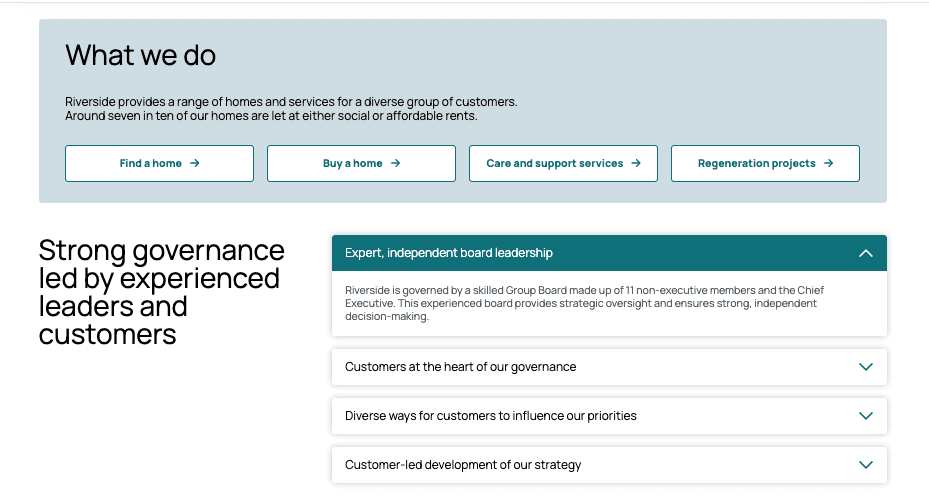
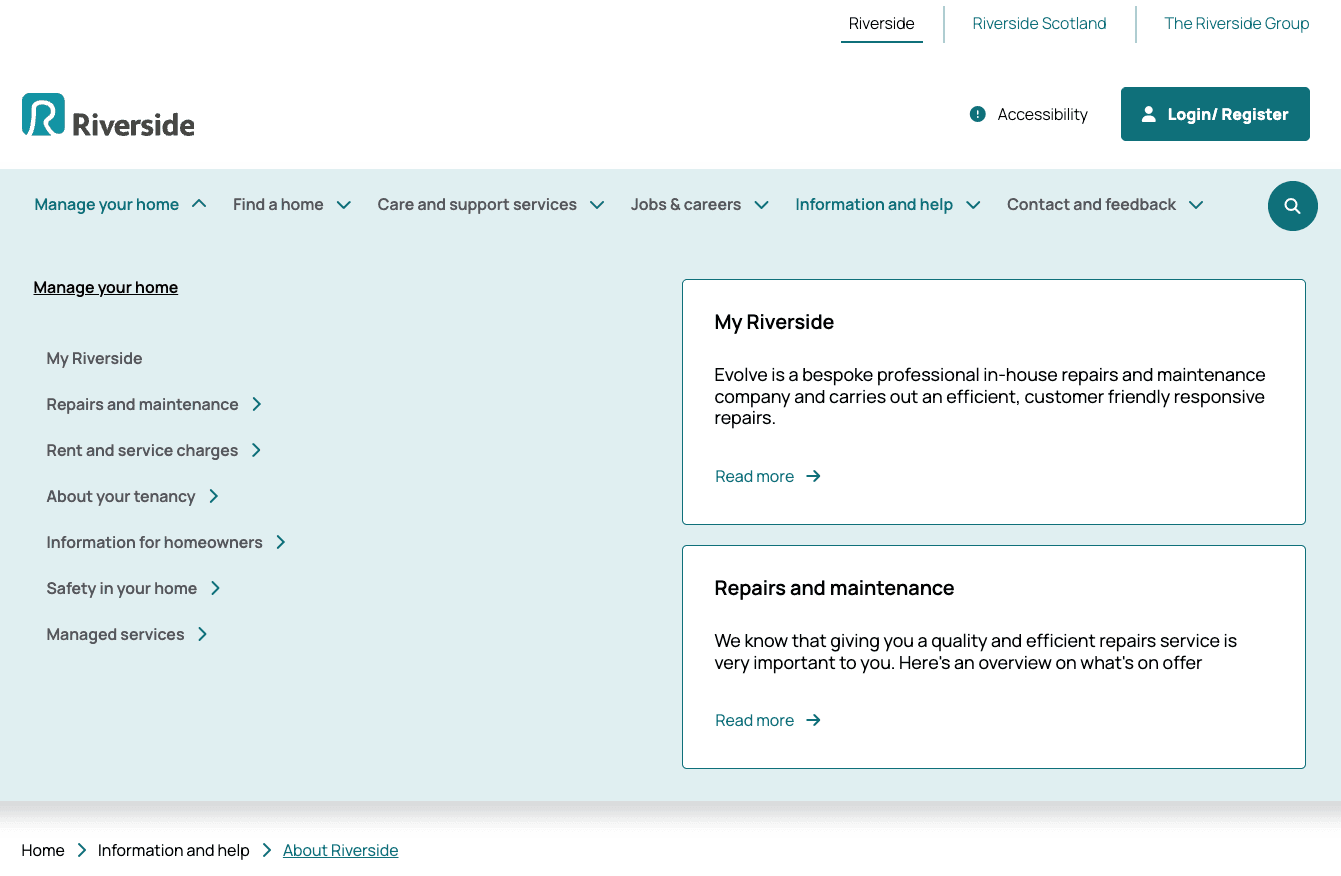
Riverside’s digital presence spans multiple audiences and regions, including the main customer site, a Scotland-specific site, and a corporate platform. I led the content design, conducted a full audit of the existing ecosystem, finalised the new information architecture, and designed the content migration and governance model to support long-term scalability.

The challenge wasn’t just restructuring pages, it was aligning three digital properties under a coherent content strategy while serving very different user needs.

Role:

UX Content Designer

  • Led full content audit across all properties

  • Identified duplication, gaps, and structural inconsistencies

  • Facilitated cross-team alignment sessions

  • Defined governance model for post-launch sustainability

Tools:

Figma, Squiz DXP, Wordpress, Jira

  • Finalised new information architecture

  • Designed migration mapping and content prioritisation

  • Preparing UAT, beta rollout, and analytics-informed iteration


Overview

Designing and Governing a Multi-Site Content Ecosystem: Riverside Group (Main, Scotland & Corporate Sites)

(In progress – internal UAT and phased launch)

Riverside’s digital presence spans multiple audiences and regions, including the main customer site, a Scotland-specific site, and a corporate platform. I led the content design, conducted a full audit of the existing ecosystem, finalised the new information architecture, and designed the content migration and governance model to support long-term scalability.

The challenge wasn’t just restructuring pages, it was aligning three digital properties under a coherent content strategy while serving very different user needs.

Role:

UX Content Designer

  • Led full content audit across all properties

  • Identified duplication, gaps, and structural inconsistencies

  • Facilitated cross-team alignment sessions

  • Defined governance model for post-launch sustainability

Role:

UX Content Designer

  • Led full content audit across all properties

  • Identified duplication, gaps, and structural inconsistencies

  • Facilitated cross-team alignment sessions

  • Defined governance model for post-launch sustainability

Tools:

Figma, Squiz DXP, Wordpress, Jira

  • Finalised new information architecture

  • Designed migration mapping and content prioritisation

  • Preparing UAT, beta rollout, and analytics-informed iteration


Tools:

Figma, Squiz DXP, Wordpress, Jira

  • Finalised new information architecture

  • Designed migration mapping and content prioritisation

  • Preparing UAT, beta rollout, and analytics-informed iteration


The challenges

There is currently an issue to be investigated in the way that the Microsoft FastTrack portal is utilized to its full potential regarding a community of practice.

The focus of this project began with addressing how to enable, support and enhance the Microsoft FastTrack portal using AI as a tool.

Phase 1: Content Audit & Ecosystem Mapping

Understanding the Landscape

Audience & Language Clarity

Ownership & Sustainability

I conducted a structured audit across the main, Scotland, and corporate sites to understand how content was organised and maintained across the ecosystem.

I reviewed:

  • Content overlap across sites

  • Structural inconsistencies

  • Navigation differences

  • Formatting and content types

This helped me identify patterns at a system level rather than focusing on individual pages.

The audit revealed that several sections were serving multiple audiences at once, creating confusion.

I identified:

  • Blurred lines between customer and corporate content

  • Regional distinctions that weren’t clearly communicated

  • Inconsistent terminology for the same services

The issue wasn’t incorrect information — it was unclear segmentation and structure.

Beyond structure, I uncovered governance gaps that had contributed to duplication over time.

There was:

  • No clear content ownership model

  • Inconsistent update processes

  • No structured review cycle

This shifted the project from a redesign to a long-term systems improvement.

Key insight from Phase 1

The core issue wasn’t content volume, it was structural clarity and governance.

The ecosystem needed clearer segmentation and defined ownership to remain scalable and sustainable.

Phase 2: Information Architecture & Migration Strategy

The new IA was designed to:

  • Separate customer journeys from corporate content

  • Create clearer regional distinctions

  • Reduce duplication through shared structures

  • Support accessibility and task-based navigation

While formal user research was not conducted at this stage, IA decisions were informed by collaborative audits and stakeholder alignment workshops. Validation is planned through beta testing and post-launch analytics.

I also designed the migration framework, mapping legacy content into the new structure with clear prioritisation rules.

The challenges

Content duplication and inconsistent messaging across sites

  • Blurred boundaries between customer, regional, and corporate audiences

  • Legacy structure not aligned to current services

  • No clear governance model for future content creation

  • Risk-heavy migration across multiple properties

The goal: create a scalable, audience-first content system that works across all sites — now and long-term.

The challenges

Content duplication and inconsistent messaging across sites

  • Blurred boundaries between customer, regional, and corporate audiences

  • Legacy structure not aligned to current services

  • No clear governance model for future content creation

  • Risk-heavy migration across multiple properties

The goal: create a scalable, audience-first content system that works across all sites — now and long-term.

Phase 1: Content Audit & Ecosystem Mapping

Phase 1: Content Audit & Ecosystem Mapping

Understanding the Landscape

Audience & Language Clarity

Ownership & Sustainability

I conducted a structured audit across the main, Scotland, and corporate sites to understand how content was organised and maintained across the ecosystem.

I reviewed:

  • Content overlap across sites

  • Structural inconsistencies

  • Navigation differences

  • Formatting and content types

This helped me identify patterns at a system level rather than focusing on individual pages.

The audit revealed that several sections were serving multiple audiences at once, creating confusion.

I identified:

  • Blurred lines between customer and corporate content

  • Regional distinctions that weren’t clearly communicated

  • Inconsistent terminology for the same services

The issue wasn’t incorrect information — it was unclear segmentation and structure.

Beyond structure, I uncovered governance gaps that had contributed to duplication over time.

There was:

  • No clear content ownership model

  • Inconsistent update processes

  • No structured review cycle

This shifted the project from a redesign to a long-term systems improvement.

Understanding the
Landscape

I conducted a structured audit across the main, Scotland, and corporate sites to understand how content was organised and maintained across the ecosystem.

I reviewed:

  • Content overlap across sites

  • Structural inconsistencies

  • Navigation differences

  • Formatting and content types

This helped me identify patterns at a system level rather than focusing on individual pages.

Audience & Language Clarity


The audit revealed that several sections were serving multiple audiences at once, creating confusion.

I identified:

  • Blurred lines between customer and corporate content

  • Regional distinctions that weren’t clearly communicated

  • Inconsistent terminology for the same services

The issue wasn’t incorrect information — it was unclear segmentation and structure.

Ownership & Sustainability

Beyond structure, I uncovered governance gaps that had contributed to duplication over time.

There was:

  • No clear content ownership model

  • Inconsistent update processes

  • No structured review cycle

This shifted the project from a redesign to a long-term systems improvement.

Key insight from Phase 1

The core issue wasn’t content volume, it was structural clarity and governance.

The ecosystem needed clearer segmentation and defined ownership to remain scalable and sustainable.

Phase 3: Launch & Governance (In Progress)

Content duplication and inconsistent messaging across sites

  • Blurred boundaries between customer, regional, and corporate audiences

  • Legacy structure not aligned to current services

  • No clear governance model for future content creation

  • Risk-heavy migration across multiple properties

The goal: create a scalable, audience-first content system that works across all sites — now and long-term.

Let’s connect and create something impactful together!

Key insight from Phase 1

The core issue wasn’t content volume, it was structural clarity and governance.

The ecosystem needed clearer segmentation and defined ownership to remain scalable and sustainable.

Phase 2: Information Architecture & Migration Strategy

Phase 2: Information Architecture & Migration Strategy

The new IA was designed to:

  • Separate customer journeys from corporate content

  • Create clearer regional distinctions

  • Reduce duplication through shared structures

  • Support accessibility and task-based navigation

While formal user research was not conducted at this stage, IA decisions were informed by collaborative audits and stakeholder alignment workshops. Validation is planned through beta testing and post-launch analytics.

I also designed the migration framework, mapping legacy content into the new structure with clear prioritisation rules.

Phase 3: Launch & Governance (In Progress)

Content duplication and inconsistent messaging across sites

  • Blurred boundaries between customer, regional, and corporate audiences

  • Legacy structure not aligned to current services

  • No clear governance model for future content creation

  • Risk-heavy migration across multiple properties

The goal: create a scalable, audience-first content system that works across all sites — now and long-term.

Let’s connect and create something impactful together!

Let’s connect and create something impactful together!

Create a free website with Framer, the website builder loved by startups, designers and agencies.